
Local Event Tickets in Toronto, ON
Showing all 3 results
NPH League – NPA Day Pass | Session 3 Friday Afternoon
$9.99 CADFriday afternoon NPA at Royal Crown School! FEIA takes on Polaris Prep in a 1:00 PM matchup on the main court.
NPH League – NPA Weekend Day Pass | Session 3 Saturday
$9.99 CADFive games, one ticket! A full Saturday of NPA basketball at Royal Crown School, plus a WNPA nightcap between Redmond and Royal Crown.
NPH League – NPA Weekend Day Pass | Session 3 Sunday
$9.99 CADNPA Session 3 wraps up Sunday! Three games at Royal Crown School featuring Lennoxville Prep, Rose Academy, St. Jude Prep, King Heights, Polaris Prep and Ridley College.
City of Toronto, Ontario
Quick Facts
-
 Country: Canada
-
Founded: 1793
-
Language: English (primary; over 160 languages spoken)
-
Area (city): 630 km²
-
Skyline Height: 553m (CN Tower)
-
Attractions CN Tower, Canada's Wonderland, St Lawrence Market
-
Green Space: 25% parkland (8,000+ hectares)
-
Major Highways: 401, 400, 403, 404, 407 (toll), 410, QEW
-
Public Transit: TTC subways, streetcars, and buses across the city; GO Transit regional trains and buses; UP Express airport rail link between Pearson Airport and Union Station


Toronto: Canada’s Global City 🌆
1. Introduction & Overview
Toronto is the largest city in Canada and one of the most multicultural cities in the world. Located in the province of Ontario along the northwestern shore of Lake Ontario, Toronto serves as the country’s financial, cultural, and media capital. Known for its ambition, diversity, and constant evolution, the city blends global influence with a distinctly Canadian identity 🇨🇦.
With more than 3 million residents in the city proper and over 6 million across the Greater Toronto Area (GTA), Toronto is a major international hub for business, immigration, arts, and innovation.
2. Geography & Location 🌍
Toronto sits on the northern edge of Lake Ontario, one of North America’s Great Lakes, giving the city a vital waterfront that shapes its climate, recreation, and urban development.
Key geographical features include:
- Lake Ontario and Toronto Harbour
- A network of ravines and rivers, including the Don and Humber Rivers
- The Toronto Islands, located just offshore
The city experiences a humid continental climate, with warm summers, cold winters, and distinct seasons. Spring and fall are mild and colorful, while winters bring snow and colder temperatures.
3. History 🕰️
Long before European settlement, the land now known as Toronto was inhabited by Indigenous peoples, including the Wendat, Haudenosaunee, and Anishinaabe. The area was an important meeting place and trade route due to its access to waterways and portage paths.
Origin of the Name “Toronto”
The name Toronto comes from the Mohawk word “tkaronto,” meaning “where there are trees standing in the water.” This originally referred to wooden fishing stakes placed in the waters of Lake Simcoe, north of present-day Toronto. Over time, the name became associated with the major portage route linking Lake Ontario to the upper Great Lakes and was eventually applied to the growing settlement itself. The name reflects the city’s deep Indigenous roots and long-standing role as a place of connection and exchange.
In 1793, the British founded the settlement of York, which became the capital of Upper Canada. The city was renamed Toronto in 1834 and grew rapidly through the 19th and 20th centuries due to industrialization, railways, and large waves of immigration. After World War II, Toronto transformed into the diverse, global city it is today.
4. Demographics & People 👥
Toronto is often cited as one of the most diverse cities on Earth.
- Over half of its residents were born outside of Canada
- More than 200 ethnic origins are represented
- Over 180 languages are spoken
Immigrant communities from South Asia, East Asia, the Caribbean, Africa, the Middle East, and Europe play a central role in shaping the city’s identity, culture, and economy.
5. Culture & Lifestyle 🎭
Toronto’s culture is global, inclusive, and energetic. The city is known for:
- A thriving arts and music scene
- Strong sports culture
- Progressive social values
- A fast-paced but balanced lifestyle
Residents often describe Toronto as hardworking during the week and lively on weekends, with festivals, markets, and cultural events happening year-round.
6. Neighborhoods & Districts 🏘️
Toronto is a city of neighborhoods, each with its own character.
Notable areas include:
- Downtown Toronto – Financial center, entertainment, and landmarks
- Old Toronto – Historic streets and markets
- Yorkville – Upscale shopping and dining
- Kensington Market – Eclectic, artistic, and multicultural
- Distillery District – Pedestrian-only historic district
- Scarborough – Diverse communities and natural landscapes
- North York – Business hubs and residential centers
7. Economy & Business 💼
Toronto is the economic engine of Canada.
Major industries include:
- Finance and banking
- Technology and startups
- Film and television production
- Real estate and construction
- Healthcare and education
The Toronto Stock Exchange is one of the largest in the world, and the city consistently ranks as a top destination for international investment and talent.
8. Politics & Governance 🏛️
Toronto is governed by a mayor and city council and operates within Ontario’s provincial framework. The city plays a key role in national discussions on housing, immigration, transit, climate policy, and urban development.
9. Architecture & Urban Design 🏗️
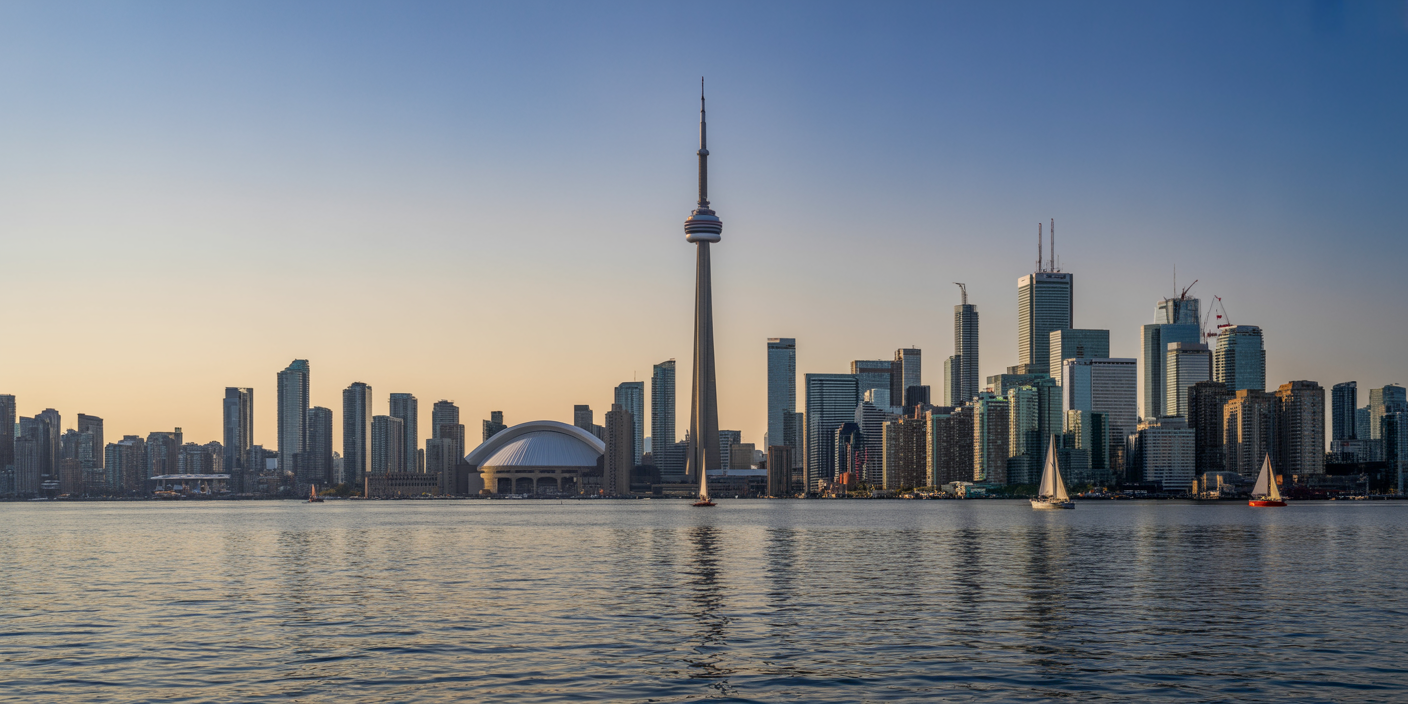
Toronto’s skyline reflects its growth and diversity, combining historic architecture with modern design.
Highlights include:
- Victorian-era residential neighborhoods
- Glass skyscrapers in the Financial District
- Revitalized industrial spaces
- Increasing focus on sustainability and mixed-use developments
The CN Tower remains the city’s most iconic landmark and a global symbol of Toronto.
10. Transportation 🚇
Toronto has one of the largest public transit systems in Canada.
- Subways, streetcars, and buses operated by the TTC
- GO Transit serving the wider GTA
- Extensive road networks and growing cycling infrastructure
- Toronto Pearson International Airport connecting the city globally
Traffic congestion remains a challenge, but ongoing transit expansion aims to improve mobility.
11. Food & Cuisine 🍽️
Toronto’s food scene mirrors its diversity.
The city offers:
- Cuisine from nearly every culture in the world
- Well-known food districts like Chinatown, Little Italy, Greektown, and Little India
- Street food, food halls, and fine dining
- A strong café and coffee culture
Toronto is widely regarded as one of North America’s best cities for international food.
12. Attractions & Landmarks 📍
Popular attractions include:
- CN Tower
- Royal Ontario Museum
- Art Gallery of Ontario
- Ripley’s Aquarium of Canada
- St. Lawrence Market
- Toronto Islands
Parks, waterfront trails, and green spaces are spread throughout the city.
13. Entertainment & Nightlife 🎶
Toronto is Canada’s entertainment capital.
- World-class theater and live performances
- Major concert venues and nightlife districts
- Toronto International Film Festival (TIFF)
- Professional sports teams, including the Raptors, Maple Leafs, and Blue Jays
14. Education & Innovation 🎓
Toronto is home to leading institutions such as:
- University of Toronto
- Toronto Metropolitan University
- York University
The city is a global leader in artificial intelligence, medical research, fintech, and creative industries.
15. Sports & Recreation 🏀
Sports are deeply embedded in Toronto’s culture.
- Major professional teams across multiple leagues
- Extensive recreational sports programs
- Cycling paths, waterfront activities, and urban parks
16. Tourism & Travel Tips ✈️
- Best time to visit: May through October
- Summers feature festivals and outdoor events
- Winters are cold but lively and festive
- Public transit makes the city easy to explore
Toronto is considered safe, welcoming, and visitor-friendly.
17. Challenges & Future Outlook 🔮
Toronto faces challenges common to global cities, including housing affordability, traffic congestion, and climate adaptation. Despite this, the city continues to grow, innovate, and attract talent from around the world.
18. Fun Facts & Trivia ✨
- Toronto’s PATH system is the world’s largest underground shopping network
- The city has extensive ravine systems unique among major cities
- Its name reflects Indigenous fishing practices and ancient trade routes
19. Conclusion
Toronto is a city defined by diversity, opportunity, and constant change. Rooted in Indigenous history and shaped by generations of newcomers, it stands today as one of the world’s most dynamic and globally connected cities. Whether visiting, living, or investing, Toronto offers an urban experience that is both international and unmistakably its own.